Apartment and Multi-Unit Water Damage in Compton, CA
Water in one unit rarely stays in one unit. The restoration team traces it through shared ceilings and walls, dries each affected unit and keeps a separate record for the owner and each tenant.
(888) 563-9619Water still spreading? Call the Compton crew- IICRC S500 drying goal
- Truck-mounted extraction
- Daily moisture logs
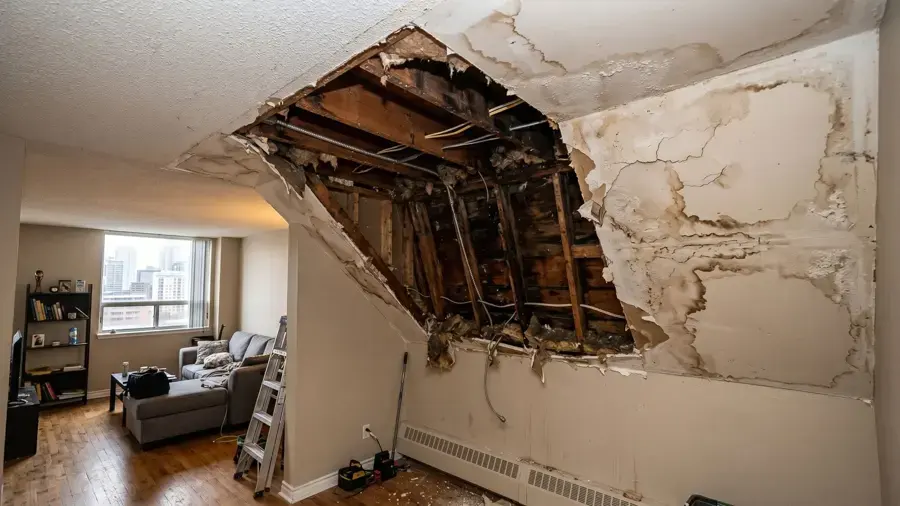
What to do right now about apartment and multi-unit water damage
- 1
Stop the source upstairs
Knock on the unit above, or reach the manager, and get the fixture or the building valve shut off.
- 2
Stay clear of wet fixtures
Do not use a ceiling light or fan that has water in or around it.
- 3
Move belongings
Move electronics, papers and furniture away from the wet ceiling and floor.
- 4
Photograph each unit
Photograph every wet ceiling, wall and floor, then call for tracing and drying.
How the restoration team handles apartment and multi-unit water damage in Compton
- 01
Map the moisture
The tech who does the walkthrough maps moisture with a pinless meter and thermal imaging before any equipment goes down, so the plan matches what is actually wet.
- 02
Extract the water
The extraction crew pulls standing water with truck-mounted extraction so it leaves the building instead of wicking into the next room.
- 03
Dry the structure
The drying team sets air movers to the evaporation load of each room and runs LGR dehumidifiers, with desiccants for dense Class 4 materials.
- 04
Verify and document
Readings are logged daily, and the equipment comes out only when wet materials sit within 2 to 4 points of a dry reference in the same building.
What does apartment and multi-unit water damage cost in Compton, CA?
In Compton, CA, apartment water damage restoration typically runs $1,500 to $4,000 per affected unit, and $5,000 to $15,000 or more when several units, hallways or ceilings are involved, depending on the water category and how far it traveled.
One unit, source only
- Extraction
- Moisture map
- Drying equipment
Source plus unit below
- Ceiling drywall removal
- Two units dried
- Per-unit logs
Several units or halls
- Multi-unit tracing
- Hallway and stair drying
- Owner and tenant documentation
For a planning number, try the Compton water damage cost calculator. A firm figure comes from the walkthrough and the moisture map.
Compton has a large stock of garden and courtyard apartments, duplexes and small multi-unit buildings from the 1960s through the 1980s. In a stacked building, an overflowing tub, a failed toilet supply or a washer hose upstairs sends water through the floor into the ceiling of the unit below, and sometimes down a shared wall into a third unit.
How water moves through an apartment building
- Down through the subfloor and joists into the ceiling of the unit below
- Along plumbing chases and shared walls into the neighbor's kitchen or bath
- Across slab floors on the ground level into the next unit's carpet
- Into light fixtures and ceiling fans, which makes the electrical side a safety check first
Tracing the water unit by unit
The tech who does the walkthrough starts at the source unit and follows the water with meters and thermal imaging into every unit around it. Each unit gets its own moisture map, photos and drying log. That record matters because the building owner, the tenants and different insurers may each be responsible for different parts of the loss.
Drying a stacked building
- The extraction crew pulls standing water in the source unit and any unit below.
- Wet ceiling drywall that is sagging comes down in a controlled way before it falls.
- Air movers and LGR dehumidifiers go into each wet unit, sized to that unit's evaporation load.
- Readings are taken in every unit daily until each one reaches the drying goal.
Water coming through a Compton apartment ceiling? Keep clear of wet light fixtures and call the restoration team.
(888) 563-9619The California Department of Insurance explains how homeowners, landlord and renters policies differ, and Ready.gov covers electrical safety around water.
Owners and tenants: two different claims
The building structure usually falls under the owner's policy, while a tenant's furniture and belongings fall under a renters policy if there is one. Separate documentation for each unit makes both claims simpler.
Compton, CA and the Hub City neighbors
The Compton restoration crew covers every Compton ZIP, 90220 through 90224, plus Lynwood, Paramount, Carson, Gardena, Willowbrook, Rancho Dominguez, North Long Beach, Bellflower and South Gate.
Give the cross street and which room is wet so the right extraction and drying gear goes out on the first trip.
See every neighborhood and ZIP coveredApartment and Multi-Unit Water Damage questions
Who pays when water comes from the unit above?
It depends on the cause, the lease and the policies involved. The building owner's policy usually covers the structure, and a renters policy covers a tenant's belongings. Coverage depends on the policies, so it is worth checking with your own insurer.
Is it safe to stay in the unit below?
Usually, once the water is stopped and any wet light fixtures are switched off. A sagging ceiling is a hazard and comes down before it falls.
Does every unit get checked?
Every unit around the source that could have taken water gets a meter check, including the units beside and below it. Water often travels farther than the visible stains.
Can a property manager call for the whole building?
Yes. Managers and owners of Compton apartment buildings can call for the source unit and any affected units at the same time.
How long does drying take in an apartment?
A contained Class 1 or 2 loss usually dries in three to five days per unit. Ceilings and multi-layer floors can take longer.
What about my furniture and belongings?
Wet belongings are moved, photographed and dried where possible. Items touched by contaminated water are listed for the claim and usually discarded.
Water between Compton apartment units?
The restoration team traces it through every unit, dries each one and keeps separate records for owners and tenants.